


Maturity Circle
This tool was developed by Jim Putman to help the body understand where they are in their walk with Jesus and recognize it in others. By learning where others are on their journey, we will be equipped to help give them what they need to progress. Let’s get started.
There is much more we would like to say about this, but it is difficult to explain, especially since you are spiritually dull and don’t seem to listen. You have been believers so long now that you ought to be teaching others. Instead, you need someone to teach you again the basic things about God’s word. You are like babies who need milk and cannot eat solid food. For someone who lives on milk is still an infant and doesn’t know how to do what is right. Solid food is for those who are mature, who through training have the skill to recognize the difference between right and wrong.
Hebrews 5:11-14
If you have ever taken a karate class then you know you enter at the level of a white belt and progress through the belts until you eventually make black.In these phases of progression, they are not evaluations of your worth but more so evaluations of your skill level and ability to help others who are following behind you.
A person's spiritual journey with our Lord takes a similar path. Without having language to identify it, your chances of becoming stuck in your walk will be a strong possibility. Jim Putman has developed a wheel to counteract this scenario. His diagram below allows the faithful to evaluate where they are as well as providing an outlook for where they are headed.
Maturity is simply the ability to reproduce life.
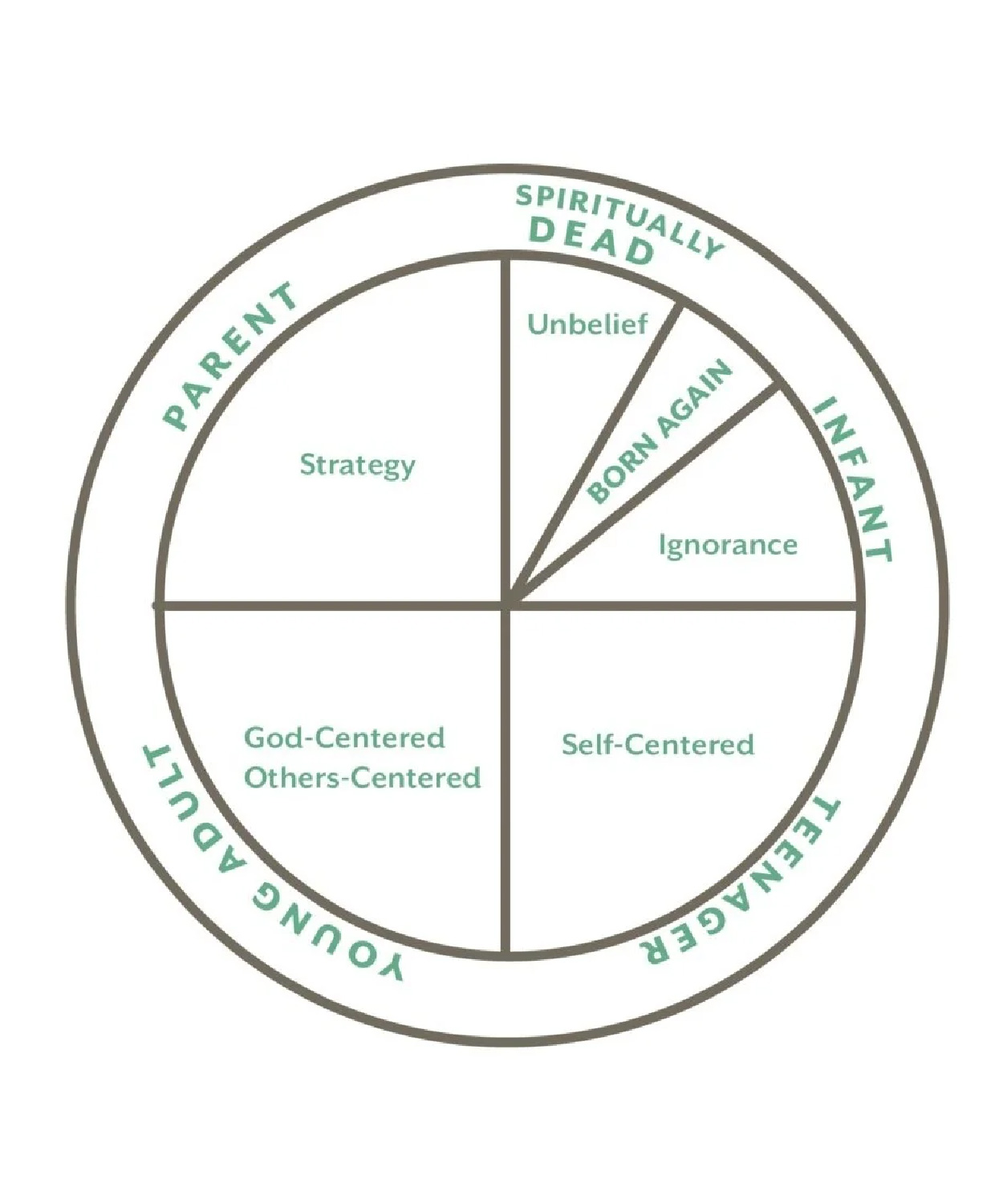
Phase 1: Spiritually Dead
Common Phrases from the Spiritually Dead:
- There is no God.
- The Bible isn’t true.
- I don’t believe in miracles.
- Evolution explains away the need for a god.
- God is a crutch for the weak.
- Christians are responsible for all of the wars.
- There are many ways to get to God.
- I am a good person.
- Good people go to heaven.
- I am a Christian because I go to church.
- If God is all love, there can’t be a hell.
- There is no absolute right or wrong.
- All roads lead to God.
The Spiritually Dead Need:
- A secure relationship with a mature believer
- A picture of the real Jesus lived out in front of them
- Answers to hard questions concerning life
- An explanation of the Gospel
- An invitation to follow Jesus
As the Lord provides an opportunity:
Share your story.
Earn the right to talk with them through by building a relationship.
Pray for the opportunity to share the Gospel.
If you don’t know the answer to a question, say,
“I don’t know, but let me get back with you. In the meantime, let me tell you what I do know about what Jesus has done for me."

Born Again: Gateway to Spiritual Growth
Jesus replied, "Very truly I tell you, no one can see the kingdom of God unless they are born again." "How can someone be born when they are old?" Nicodemus asked. "Surely they cannot enter a second time into their mothers womb to be born!" Jesus answered, "Very truly I tell you, no one can enter the kingdom of God unless they are born of water and Spirit. Flesh gives birth to flesh, but the Spirit gives birth to spirit. You should not be surprised at my saying, 'You must be born again.' The wind blows wherever it pleases. You hear its sound, but you cannot tell where it comes from or where it is going. So it is with everyone born of the Spirit."
John 3:3-8
Phase 2: Spiritual Infants
Once born again, the believer is now a spiritual infant. Spiritual infants are characterized by ignorance, confusion and dependence with a contagious zeal for our Lord. As they learn "christianese" they may be able to fool others into believing they have achieved a higher level of maturity when actually there is little substance behind their words just yet. Just like in the real world with toddlers, the majority of people in this phase believe they can do this walk all by themselves, and unfortunately they try.
Spiritual Infants Are:
- Ignorant of what the Scriptures actually teach and their purpose
- Ignorant about how the church works and get frustrated with it
- Have unrealistic expectations on others
- Define themselves as the culture defines them
- Have a worldly perspective about life mixed with some truth
Common Phrases from Spiritual Infants:
- I gave my life to Jesus, but I can do this by myself.
- I don’t have time to be in relationship with others.
- I have Jesus, I don’t need the church.
Spiritual Infants Need:
- A spiritual parent
- Protection and care
- The Word explained to them
- To see the habits of a mature believer
How to Help a Spiritual Infant:
- Give them your time.
- Teach them about the spiritual battle that surrounds them.
- Teach them about the process of spiritual formation.
- Explain to them the process of discipleship and what habits need to be forming.
- Teach them to read the Word, the importance of walking together, serving, praying, giving, and humility, and to share their story with all who will listen.
Phase 3: Spiritual Teenagers
Spiritual teenagers are still young in their faith and their understanding of Biblical concepts. The Word is becoming their road map for life. They are also self-centered and usually don't have a handle on their pride. As with regular teenagers, they are often controlled by their emotions.
Spiritual Teenagers:
- Are excited over deep relationships
- Remember who they were prior to Jesus
- Understand the language
- Are disillusioned with their high expectations of others
- Believe that their feelings are most important
- Lack wisdom about how to use what they are learning
- Believe that nobody cares about them enough
- Mimic Christian behavior to impress others
- Know more about what Christians say than what the Word says
- Will serve begrudgingly, but then judge others for not serving
Common Phrases from Spiritual Teenagers:
- I love my small group and never want it to change.
- This church is getting too big and doesn’t feel good anymore.
- My small group is not taking care of my needs.
- No one is spending enough time with me.
- I didn’t like the music today, if only they would do this.
- I am not being fed at this church.
- Most of their talking starts with the word “I.”
Spiritual Teenagers Need:
- A spiritual parent
- To learn how to feed themselves
- An understanding of who they are in Christ
- To be in relationship with Jesus
- To learn how to have relationships with others
- Appropriate expectations of other believers
- An understanding of their giftedness
Help by Teaching Them:
- Who God is
- Who Satan is
- About the world and sin and the end result
- About the rescue mission
- About our part
- About the Bible being inspired and how to self-feed
- To handle conflict biblically, give wise counsel, and accept criticism
- To hear God’s Word
- To have a Godly family
- To be involved in the local church and understand how it works
Phase 4: Spiritual Young Adults
Spiritual adults are action-centered, God-centered and zealous, but they haven’t thought yet about the mandate to produce disciples. They trust Jesus and understand that there is a cost to following Him. The Spirit's voice becomes louder than their internal voice.
Spiritual Adults:
- Desire to serve God
- May have pride if they lead a person to Christ or on the flip side, be discouraged if he/she doesn’t accept Him
- Desire to serve others, but are not STRATEGIC in developing others
- Are black-and-white about matters of the church
- Mistakenly believe the Gospel depends on them, not God
Common Phrases from Spiritual Adults:
- I love my group, but others need this as well.
- I could lead a group...with a bit of help.
- Look how many people are at church today, awesome!
- How can I better serve the people in this group?
- I called 60 people from church this week.
- _____________ is mad and left the church. It must have been something I said.
- I’m in over my head.
Spiritual Adults Need:
- A spiritual parent who will walk with them through ministry experiences
- Encouragement
- Help in navigating complex issues in ministry
- Healthy boundaries concerning their families
- Guidance in the expectations of people they serve
How to Help Them:
- When to speak and when to remain silent
- The key concepts of the Christian faith
- The difference between opinion and fact
- Accountability to leaders and the mission of the church as a whole
- When to confront and the mandate of going to their brother
- To see God’s value on every life and that it’s for God’s glory, not theirs
- To be LEARNERS and defend their faith
- To follow through on commitments
- To be obedient in their finances and their time
- To see the importance of bringing others along
Phase 5: Spiritual Parents
Spiritual Parents have arrived at a place where the majority of their thinking is that they exist to make people better. Their understanding of "legacy" incorporates the changing of entire family units through the process of discipleship. Although difficult, they live a life like Jesus with the expectation of future fruit and they give their lives as an offering to bring others into maturity.
Spiritual Parents:
- Feed themselves
- Pray with their wives and kids
- Feel compelled to find people to disciple
- Love the church and understand there is no plan B
- Never say ‘I love Jesus but hate church”
- Support the church even in disagreements
- Have a COACHING mindset
- Look to help others mature
Common Phrases from Spiritual Adults:
- I’m sharing the Gospel with a friend from work today.
- I am fasting every week for the Lord to do immeasurably more in the people I am discipling.
- Discipling my kids is a priority as I disciple others.
- Discipling is hard, but my Savior has mandated it, and it is the path to abundant life.
- Let me pray for you right now.
- I don't know what I am doing sometimes in discipling, but Jesus' will be done, as this is His plan and not mine.
- I walked myself through a Kairos moment today.
Spiritual Parents Still Need:
- Someone pouring into them and holding them accountable.
- Deep community with other believers.
- To remember that spiritual growth is never finished.
Practical Tip
Learning to really listen to people can yield an accurate picture of where they are and how you can best help them. It is not a church social system or hierarchy, and when it is confused as such, it can be unhealthy. All of us are intended to walk in these life cycle phases and, Lord willing, pass through them. Normally, passing through a phase produces pain, and this is why it is so important not only to recognize it but to have a spiritual parent to walk with them as well.
When teaching the Maturity Circle, re-emphasize the above. Encourage them where they are and have them practice listening to others. As they evaluate where others are on the circle ask them how they can best help them based upon their evaluation.
Another useful tool is allowing them to overlay their APEST gift on top of the Putman Circle. This can give a good idea of what maturity looks like for their specific gift.

Copyright 2026 Brown To Green
All Rights Reserved.