


Learning Circle
This tool is designed to teach people how to hear the voice of the Lord and respond to it. Of all the tools, we encourage you to become proficient in this one, to become a master craftsman if you will. Heaven is waiting to break in to the lives of His people. Be the ambassador. Let’s get started.
The time has come, the kingdom has come near.
At the end of the Sermon on the Mount, Jesus introduces, through the Parable of the Wise and Foolish Builder, the two fundamental questions of Christian spirituality: What is God saying to you and what are you going to do about it?
But how can we do what God is asking of us if we don’t know what he’s saying? What Jesus illuminates in Mark 1:14-15, is how to discern what God is saying. There are times when it feels like our world and God’s world is colliding (called a Kairos moment). When we have those times, we can step more fully into the Kingdom and wrestle with these two questions through a process of Repent and Believe.
After John was put in prison, Jesus went into Galilee, proclaiming the good news of God. “The time has come,” he said. “The kingdom of God has come near. Repent and believe the good news!”
Mark 1:14-15 | Jesus Announces the Good News
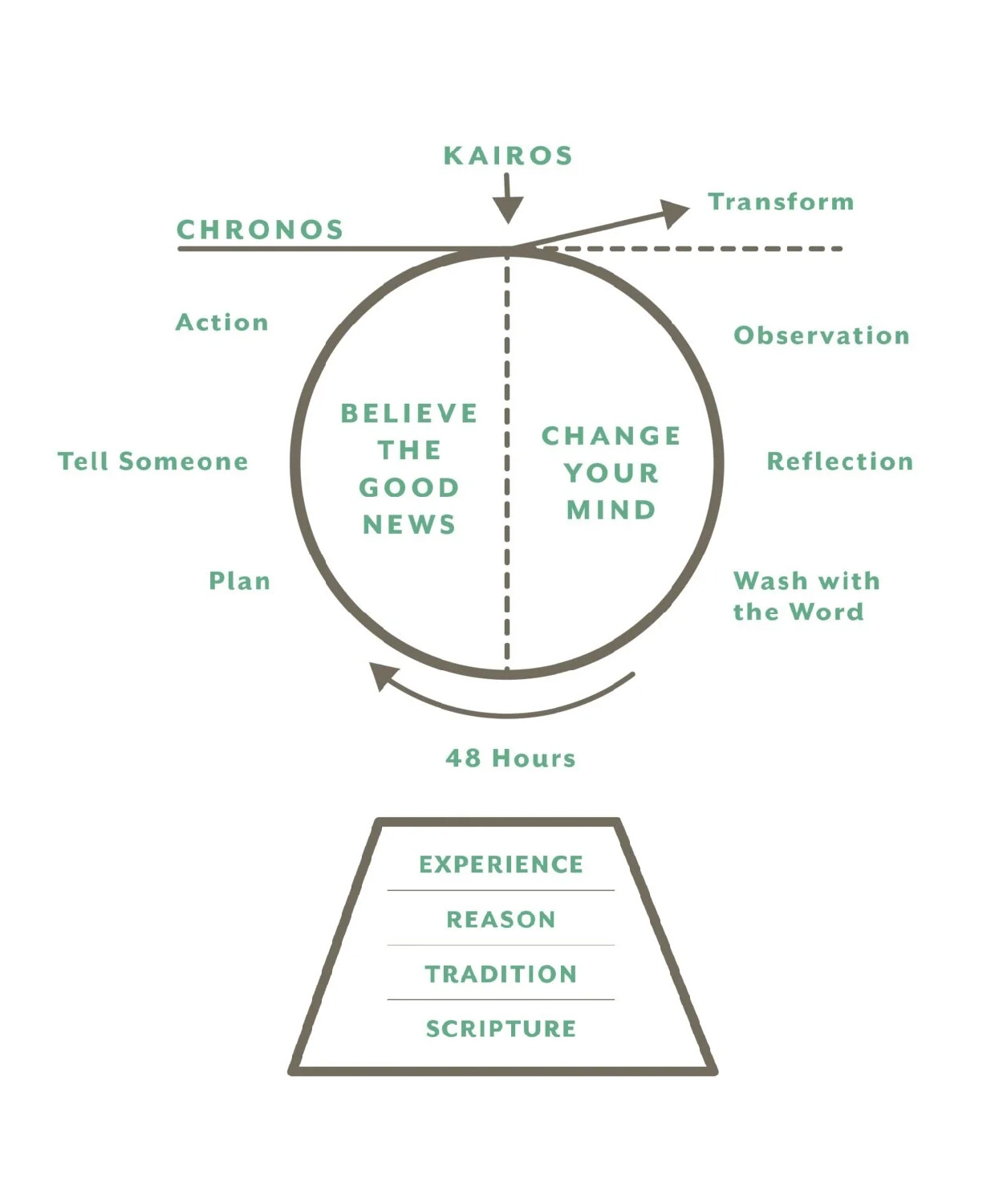
Jesus said, “The Kairos has come”
Kairos simply means an opportune time. In this particular instance, Jesus is saying that the opportune time for heaven to come crashing into earth is near, but we must first change our mind and believe the good news.
How do we do that?
Mike Breen has laid out six simple steps for each kairos moment and we will elaborate on each one.
- Observe: “What just happened?", “What is happening?” “What do you see?”
- Reflect: "Why did this happen?" This is usually the heart of the matter.
- Discuss: "Here’s what I heard you say; here’s what I’m reminded of."
- Plan: What do I do about what God seems to be saying to me?
- Accountability: Report their plan within 48 hours to their Spiritual Parent.
- Act: Carry-out the plan.
How to walk someone through a Kairos moment
Observation
The observation phase is the place where Kairos begins. Observations can be made on any plane of existence as all things have been made through Him, for Him and by Him (Colossians 1). Remember as well, that Jesus taught his disciples by having them make observations in nature (Matthew 6). Observations can be made from the Word (what stuck out to you), and from doing “High’s and Low’s” around the table. Where ever the observation comes from. we are training disciples to see that Jesus is all around them all the time. (John 15)
Reflection
Getting to the "why" or "reflection" piece is key to the Learning Circle because it allows us to actually speak the truth about the situation and to speak it out loud. Don't be afraid to press into the "why". A wise man once said, "people already have the answer inside them, they just need help saying it out loud." Once this is spoken out loud, the application of the scripture becomes life-giving.
Wash With The Word
During the discussion phase we use the Wesley quadrilateral. The Wesley quadrilateral is a series of filters which ensure that truth is spoken into the reflection. The Wesley quadrilateral filters are as follows and are in order of importance.
- Scripture
- Early Church Tradition
- Godly Reason
- Experience
Stick with this language during the discussion phase, “Here’s what I heard you say, and here’s what I am reminded of …” It is imperative to use this language as it keeps us from telling others what to do.
Making a Plan
Making a plan is also critical in the process of discipleship for without a plan we cannot believe the good news. To believe the good news is to “ginosko” the good news. “Ginosko” means to have experiential knowledge of the good news which in turns means there is something to do. This is where we put our faith to the test trusting Jesus with both our obedience and the outcome and it is where He tells us, “did I not tell you that if you would believe that you would see my glory?” (John 11)
Accountability
A little accountability is all you need here. The accountability falls completely on the one in the learning circle. It is their duty to let the group know how they are progressing with their plan. Every piece of obedience yields transformation and these acts of obedience will yield a crop of righteousness. (Hebrews 12)
Action
Walk it out. This is the natural end result of working a plan and producing fruit and transformation.

Teaching Tip
1) The power of the Word behind this tool has the ability to bring forth significant transformation. Having said that, it is imperative to become a craftsman with this tool.
Hone your skills as you will get better every time you use it.
2) Do not be discouraged if you don’t get to the heart of the matter the first time. People’s hearts are sometimes revealed in layers over the course of many moments. Trust the Lord. Pray for their understanding.
3) The Learning circle is used to help people hear the voice of the Lord so that they are built up, sharpened and encouraged. If you feel you are using it to prove some one wrong, you may need to stop.
4) Knowing when to use this tool or simply just be a good listener comes with experience and abiding. Fighting for the Lord’s people should always be the heart of the practitioner.

Copyright 2026 Brown To Green
All Rights Reserved.